
44
Walking into a casino with a fixed entertainment budget often feels like a race against time. At a standard blackjack table, a cold run of cards can wipe out a few hundred dollars in twenty minutes. Slot machines churn through bankrolls even faster, spinning dozens of times per minute while quietly draining your balance. For players who want to enjoy the casino atmosphere, sip a drink, and socialize without watching their funds vanish before dinner, the search for the right game can be frustrating.
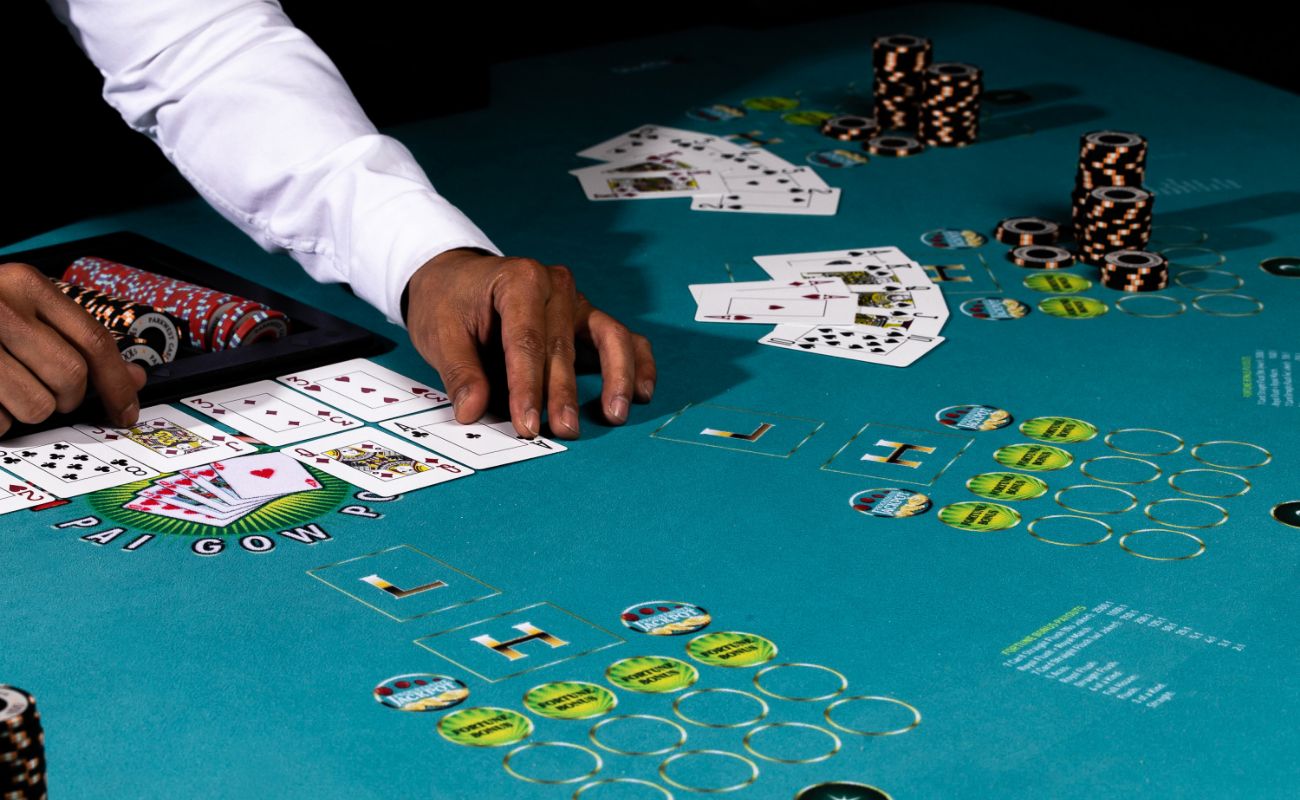
Pai Gow Poker quietly solves this dilemma. Tucked away in the pit, usually marked by relaxed players chatting with the dealer and arranging their cards with minimal stress, the game has earned a devoted following among budget-conscious gamblers. It offers a rare combination in modern casino gaming: low volatility, a remarkably slow pace, and an extraordinarily high rate of pushed hands. When played with a basic understanding of table strategy, Pai Gow Poker transforms a modest bankroll into hours of genuine entertainment.
Understanding the Structure: How Pai Gow Poker Works
Pai Gow Poker is an American adaptation of the ancient Chinese domino game Pai Gow, developed in California card rooms during the mid-1980s. Instead of tiles, the game uses a standard 52-card deck plus a single Joker, bringing the total to 53 cards.
Every participant, including the dealer, receives seven cards. The objective is to arrange those seven cards into two separate poker hands:
-
A five-card “high” hand (also referred to as the back hand)
-
A two-card “low” hand (often called the front hand)
There is only one strict structural rule you must never violate: your five-card hand must always rank higher than your two-card hand. If you set a pair of Kings in your two-card hand and only a pair of Tens in your five-card hand, you commit a foul, and your wager is automatically forfeited.
The Joker functions as a restricted wild card, commonly called a “bug.” It cannot represent any card you desire. Instead, it can only be used to complete a straight or a flush, or to act as an Ace. If you hold an Ace and a Joker in your two-card hand, you possess a pair of Aces.
Once all players set their hands, the dealer reveals their cards and sets them according to a predetermined casino rule set known as the House Way. The dealer then compares their two hands against yours.
To win your wager, both of your hands must beat both of the dealer’s hands. If the dealer beats both of your hands, you lose your wager. However, if you win one hand and the dealer wins the other, the round results in a push, meaning no money changes hands and you keep your original bet.
The Mathematics of the Push: Why Your Bankroll Survives
The primary secret behind the longevity of a Pai Gow bankroll lies in the frequency of pushed bets. In games like roulette or craps, almost every spin or roll settles a wager. In Pai Gow Poker, roughly 41% of all hands result in a push.
When you factor in that another modest percentage of rounds result in straightforward player wins, you quickly realize that your chips remain securely on the felt for the majority of the night. You are not constantly reaching back into your pocket or making trips to the ATM.
The house maintains its mathematical edge through two distinct mechanisms:
First, the dealer wins all ties on individual hands, known as “copies.” If you and the dealer both hold an Ace-King in the two-card hand, the dealer wins that specific comparison.
Second, in traditional versions of the game, the house collects a 5% commission on winning player bets. If you bet $20 and win both hands, the house pays you $19, keeping $1 as a fee.
Even with these rules in place, the overall house edge sits around 2.5% to 2.8% against an average player. While that edge is slightly higher than basic strategy blackjack, the practical outcome is far different because the money simply moves much slower. You trade rapid swings in variance for extended stability.
Pace of Play: Neutralizing the House’s Strongest Asset
Casinos rely on the law of large numbers. The more hands, spins, or rolls they expose you to per hour, the more predictably their mathematical advantage grinds down your chip stack.
Consider the standard speed of common table games:
-
A typical six-deck blackjack shoe sees roughly 60 to 80 hands per hour at a moderately full table.
-
Three Card Poker easily logs 70 or more rounds per hour.
-
Digital slot machines can register 400 to 600 spins per hour.
Pai Gow Poker operates at a fraction of that speed, averaging only 30 to 35 hands per hour.
The process takes time by design. Seven cards must be dealt to up to six player positions and the dealer. Each player must evaluate their cards, decide where to place their two-card hand, and place their layout face down. Then, the dealer systematically turns over each player’s cards, verifies that neither hand is fouled, exposes their own hand, sets it according to strict procedure, and compares the outcomes.
Because half of those 30 hands will likely push, you might only see 15 or 16 resolved betting decisions over an entire sixty-minute period. If your goal is to spend an evening in a bustling casino environment, this leisurely tempo protects your wallet from rapid erosion.
Foundational Setting Strategies for Everyday Play
You do not need a photographic memory or complex probability charts to play Pai Gow effectively. Most hands set themselves naturally, but a few basic principles ensure you minimize the house advantage and avoid giving away free equity.
Handling Pairs and Split Decisions
When you receive seven cards with no pairs, straights, or flushes, the rule is simple: place your highest card in the five-card hand, and your second- and third-highest cards in the two-card hand. This gives your front hand enough strength to salvage a push if the dealer fails to make a pair.
When holding a single pair, you almost always keep that pair in the five-card hand and place your two highest unpaired cards out front.
Decisions become interesting when you are dealt two pair. Splitting them or keeping them together determines whether you walk away with a push or a loss:
-
Low pairs (6s and lower): Always split them unless you hold an Ace as a kicker. An Ace allows you to keep both small pairs together in back while putting the Ace in front to protect the low hand.
-
Medium pairs (7s through 10s): Split them unless you hold an Ace. If you have an Ace, you can keep the pairs together if the secondary pair is low.
-
High pairs (Jacks, Queens, Kings): Always split them between the front and back hands unless you hold an Ace along with another high card.
-
Aces and any other pair: Never keep them together. Put the Aces in the five-card hand and the second pair in the two-card hand.
For three pair, the rule is straightforward: place the highest pair in your two-card hand and the remaining two pairs in your five-card hand.
The Ultimate Safety Net: Asking for the House Way
One of the most welcoming aspects of Pai Gow Poker is that you never have to guess. Unlike blackjack, where asking the dealer for advice can sometimes draw groans from adjacent players, asking for help at a Pai Gow table is entirely standard.
If you are dealt a complex hand—such as a full house with four cards to an outside straight—you can simply lay your cards on the felt and say, “House Way, please.”
The dealer will happily look at your cards and arrange them according to the strict institutional rules they follow for their own hand. Doing so instantly guarantees that your hand is set legally and with mathematically sound strategy. For beginners, this eliminates all intimidation and ensures you never foul a winning hand out of confusion.
Traditional vs. Face Up Pai Gow: Which Table Should You Choose?
In recent years, casinos have widely adopted a variation known as Face Up Pai Gow Poker. In this version, the dealer’s cards are dealt face up immediately, allowing everyone to see the dealer’s hand before setting their own.
To make the game faster and eliminate the tedious math of calculating 5% commissions, the house removes the commission entirely. Every winning bet is paid at even money (1 to 1).
In exchange for this player-friendly feature, the casino introduces a single compensating rule: if the dealer has an Ace-high hand (no pairs or better, with an Ace as their highest card), all active player hands automatically push.
Face Up Pai Gow has become a favorite for casual players. Seeing the dealer’s hand before setting your own removes all guesswork; you know exactly what rank your two-card and five-card hands need to beat. Furthermore, not paying a 5% tax on every winning hand keeps small chip stacks cleaner and easier to track. If you have a choice between the two formats, the Face Up version offers an even more relaxed experience with virtually identical long-term returns.
Avoiding the Bonus Trap: Protecting Your Chips from High-Edge Bets
If Pai Gow Poker is the ideal vehicle for bankroll preservation, its side bets are the exact opposite.
Nearly every modern table features optional wagers such as the Fortune Bonus, Progressive Jackpots, or Envy Bets. These wagers pay lucrative odds if your initial seven cards contain hands like four of a kind, a straight flush, or seven-card straights without a Joker.
While hitting a 50-to-1 or 1,000-to-1 payout sounds exhilarating, these bonus bets carry a massive house edge, often ranging from 8% to over 15%.
Placing a $5 side bet alongside a $15 base wager completely undermines the budget-stretching nature of the game. If you play 35 hands an hour and bet the bonus on every hand, you are injecting an extra $175 of high-volatility action into what was supposed to be a low-risk session.
To make your gambling budget last as long as possible, leave the side betting circles empty. Treat the main game as your anchor, and let the slow cadence of standard play work in your favor.
Structuring Your Bankroll for Maximum Table Time
Because pushes happen so often, the bankroll required to survive at a Pai Gow table is significantly lower than other table games with identical minimum bets.
For a comfortable session, a reliable benchmark is bringing 15 to 20 times the table minimum.
If you are playing at a $15 table, a starting bankroll of $250 to $300 provides exceptional longevity. At that level, a streak of bad variance rarely knocks you out of the game because stretches of pushes routinely halt downswings. It is not uncommon for a player with a $200 bankroll to sit at a $15 table for three full hours, order two drinks, chat with fellow players, and walk away within $30 of where they started.
Pai Gow Poker will rarely produce the frantic adrenaline spikes of a hot roll at the craps table, nor will it generate the explosive payouts of a lucky roulette wheel. What it offers instead is durability, low pressure, and genuine table time. For anyone who views gambling primarily as leisure rather than a high-stakes investment, Pai Gow remains the undisputed champion of the casino floor.
